
The CI/CD Quality Gate: Stop Paying Engineers to Review Bad Code
A brittle or manual CI/CD pipeline is the silent killer of engineering velocity. When developers submit pull requests that contain syntax errors, failing tests, or critical vulnerabilities, they force senior engineers to waste expensive hours acting as human spellcheckers.
At enterprise scale, human code review should be reserved strictly for business logic and architectural design. Everything else must be brutally and automatically enforced by the pipeline.
For Python workloads, I design pipelines around a non-negotiable, five-stage quality gate:
- Linting and Formatting (Black/Pylint): Eliminates syntax errors and enforces organizational style guides before a human ever reads the code.
- Unit Tests & Code Coverage: A hard gate enforcing a minimum of 80% test coverage to guarantee baseline functionality.
- Static Security Scanning: Automated vulnerability detection. The pipeline immediately fails if CVE thresholds are breached.
- Deterministic Builds: Compiling the source code using dynamic versioning.
- Ephemeral Deployments: Automatically deploying the build to an isolated non-production environment for integration testing prior to merge.
Trunk-Based Development at Enterprise Scale
You cannot achieve high-frequency, low-risk deployments using convoluted branching strategies. For enterprise environments, I strictly enforce a Trunk-Based Development model.
A typical change originates from a short-lived feature branch. When a pull request is opened against the main branch, it triggers our GitHub Actions pipeline. Instead of relying on manual oversight, the pipeline executes the five-stage quality gate and writes the deterministic results directly as a comment on the PR.
If the pipeline fails, the PR is automatically blocked. This guarantees that your senior engineers never waste time reviewing a PR that is fundamentally broken.
Securing the Software Supply Chain
Traceability is critical. Python build packages generated during the PR phase are tagged with the specific GitHub Commit SHA. If a regression occurs, there is zero ambiguity about which exact commit introduced the flaw.
Furthermore, enterprise organizations cannot rely on public repositories for proprietary code. I architect these pipelines to push private artifacts directly to a centralized JFrog Artifactory registry. To ensure strict, least-privilege security between GitHub Actions and JFrog, the OpenID Connect (OIDC) identity mappings are configured to evaluate the repository claim rather than the broader subject claim. This guarantees that only specific, authorized repositories can publish packages, keeping proprietary intellectual property secured and protecting the organization against public dependency spoofing attacks.
Deterministic Release Engineering
Once the pull request passes the automated quality gate and human review, the code is merged into main, triggering the final release sequence.
This is where the deployment becomes an auditable, immutable event:
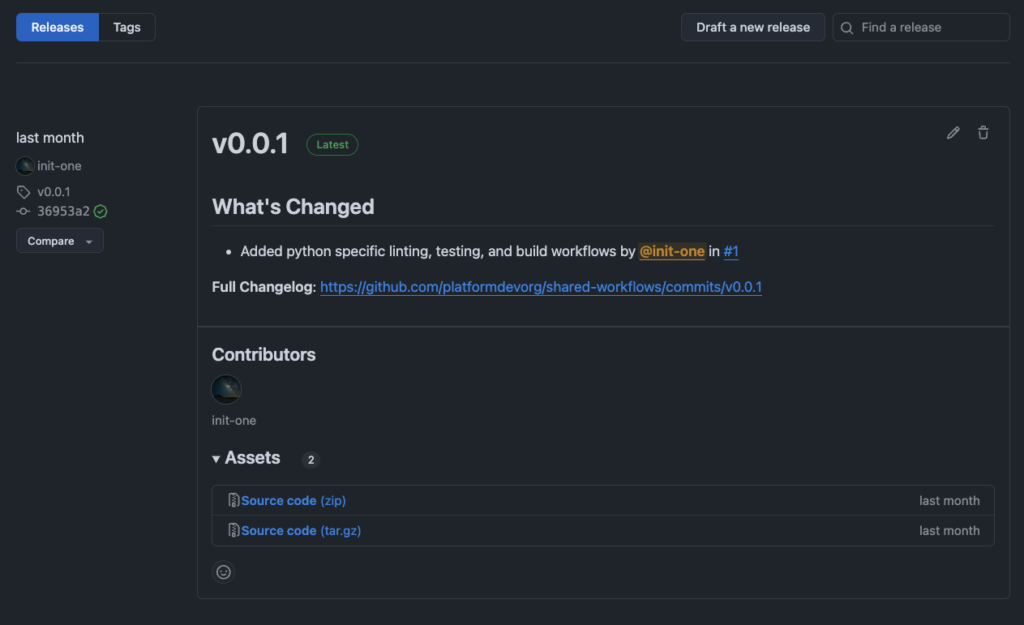
- A new tag is generated using strict semantic versioning (e.g.,
v1.0.1). - Automated release notes are appended to the repository.
- The Python package is rebuilt using the semantic tag, pushed to JFrog Artifactory, and deployed sequentially from Development through to Production.
By treating the CI/CD pipeline as an uncompromising enterprise guardrail, you eliminate deployment anxiety, protect your production environments, and return thousands of hours of productivity back to your engineering teams.
Sample Reusable Workflows: platformdevorg/shared-workflows
Struggling to enforce engineering standards without slowing developers down?
With over two decades of systems experience, I’m passionate about designing Internal Developer Platforms (IDPs) that build enterprise guardrails right into the developer workflow and accelerate time-to-market. I’m always looking to connect with other engineering leaders navigating these same scaling bottlenecks. If your team is trying to optimize CI/CD pipelines, integrate automated governance, or reduce developer friction, feel free to reach out—I’m always happy to talk shop and swap architectural strategies.
Related Posts
The Ghost in the Fabric: Debugging an Intermittent Oracle RAC Eviction

Why Are My Azure Runners Egressing From AWS?